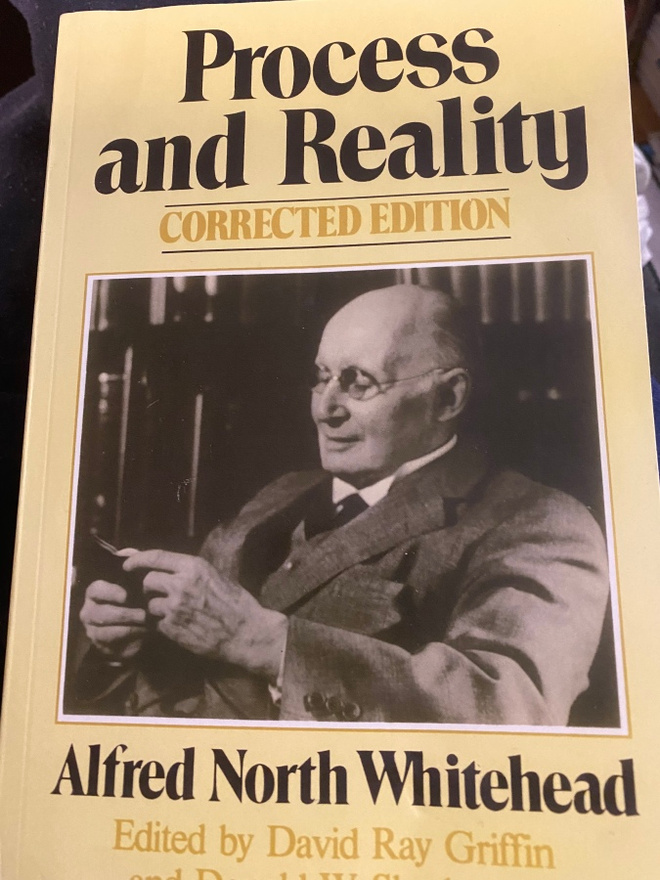
Alfred North Whitehead: Process and Reality
Osta heti
Sulkeutuu: 39pv 15h15,00 €
Kuvaus
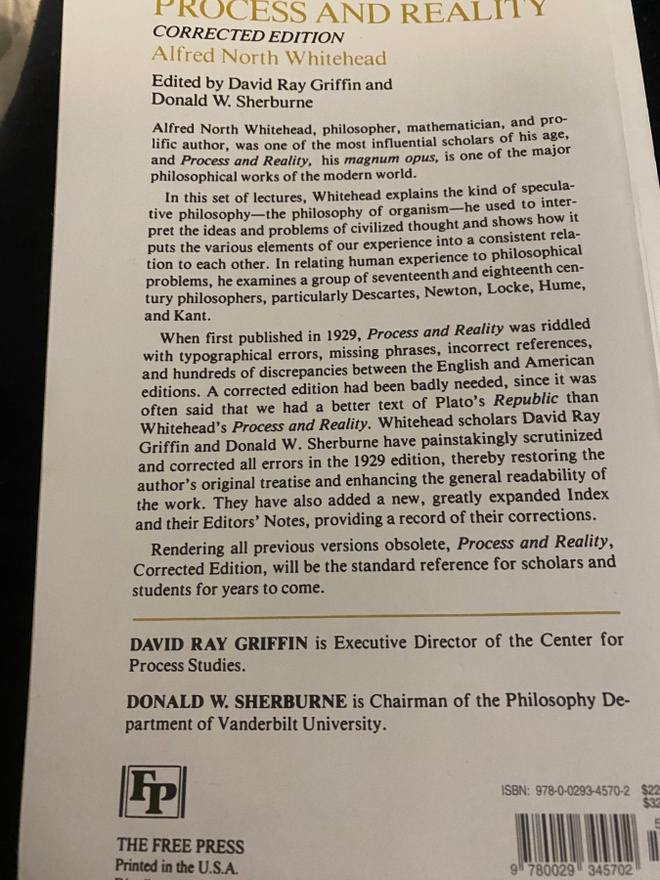
Corrected Edition, alun perin 1929, tämä laitos 1978, painos 1985, pehmeäkantinen 413 sivua. Suuri amerikkalaisen filosofian klassikko matemaatikko-filosofilta.
One of the major philosophical texts of the 20th century, Process and Reality is based on Alfred North Whitehead’s influential lectures that he delivered at the University of Edinburgh in the 1920s on process philosophy.
Whitehead’s master work in philsophy, Process and Reality propounds a system of speculative philosophy, known as process philosophy, in which the various elements of reality into a consistent relation to each other. It is also an exploration of some of the preeminent thinkers of the seventeenth and eighteenth centuries, such as Descartes, Newton, Locke, and Kant.
The ultimate edition of Whitehead’s magnum opus, Process and Reality is a standard reference for scholars of all backgrounds.
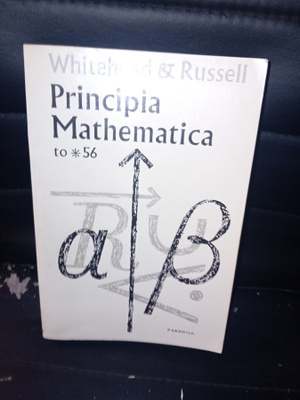
Whitehead's background was an unusual one for a speculative philosopher. Educated as a mathematician, he became, through his co-authorship with his student and disciple Bertrand Russell and publication in 1913 of Principia Mathematica, a major logician. Later he wrote extensively on physics and its philosophy, proposing a theory of gravity in Minkowski space as a logically possible alternative to Einstein's general theory of relativity. Whitehead's Process and Reality[1] is perhaps his philosophical master work.
The following is an attempt to provide an accessible outline of some of the main ideas in Whitehead's Process and Reality, based on the book itself, but guided by a general reading of secondary sources, especially I. Leclerc's Whitehead's Metaphysics. An Introductory Exposition.[2] Whitehead often speaks of the metaphysics of Process and Reality as 'the philosophy of organism'.
The cosmology elaborated in Process and Reality posits an ontology based on the two kinds of existence of entity, that of actual entity and that of abstract entity or abstraction.
The ultimate abstract principle of actual existence for Whitehead is creativity. Actual existence is a process of becoming, and “'becoming' is a creative advance into novelty".[3] It is manifest in what can be called 'singular causality'. This term may be contrasted with 'nomic causality'. An example of singular causation is that I woke this morning because my alarm clock rang. An example of nomic causation is that alarm clocks generally wake people in the morning. Aristotle recognises singular causality as efficient causality. For Whitehead, there are many contributory singular causes for an event. A further contributory singular cause of my being awoken by my alarm clock this morning was that I was lying asleep near it until it rang.
An actual entity is a general philosophical term for an utterly determinate and completely concrete individual particular of the actually existing world or universe of changeable entities considered in terms of singular causality, about which categorical statements can be made. Whitehead's most far-reaching and profound and radical contribution to metaphysics is his invention of a better way of choosing the actual entities. Whitehead chooses a way of defining the actual entities that makes them all alike, qua actual entities, with a single exception, God.
For example, for Aristotle, the actual entities were the substances, such as Socrates (a particular citizen of Athens) and Bucephalus (a particular horse belonging to Alexander the Great). Besides Aristotle's ontology of substances, another example of an ontology that posits actual entities is in Leibniz' monads, said to be 'windowless'.