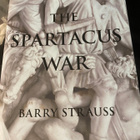
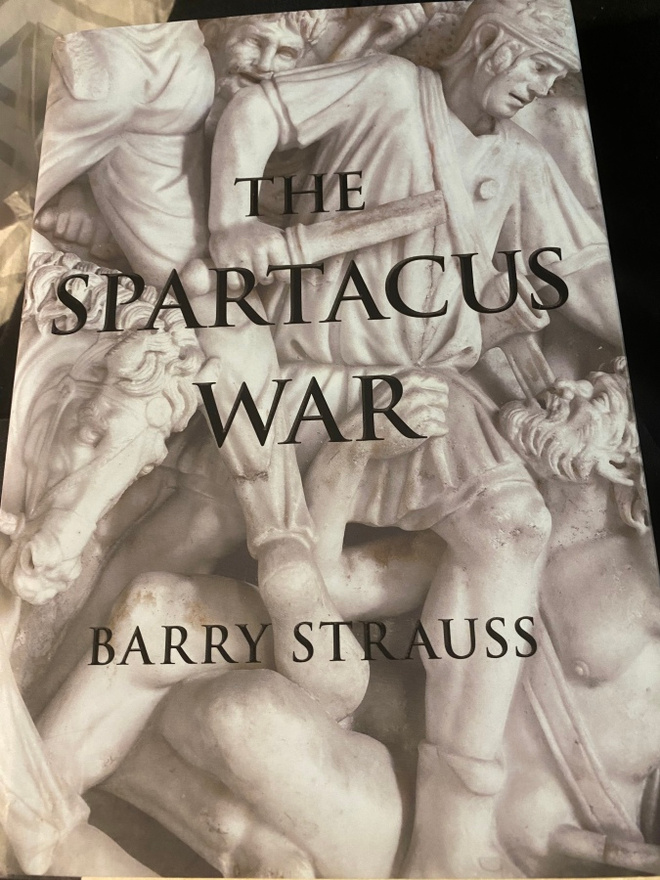
Barry Strauss: The Spartacus War
Osta heti
10,00 €
Kuvaus
Spartacus-kapinan tai -sodan historia. Simon & Schuster 2009, kovakantinen, 264 sivua. 1. painos. Muutama merkintä.
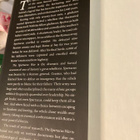
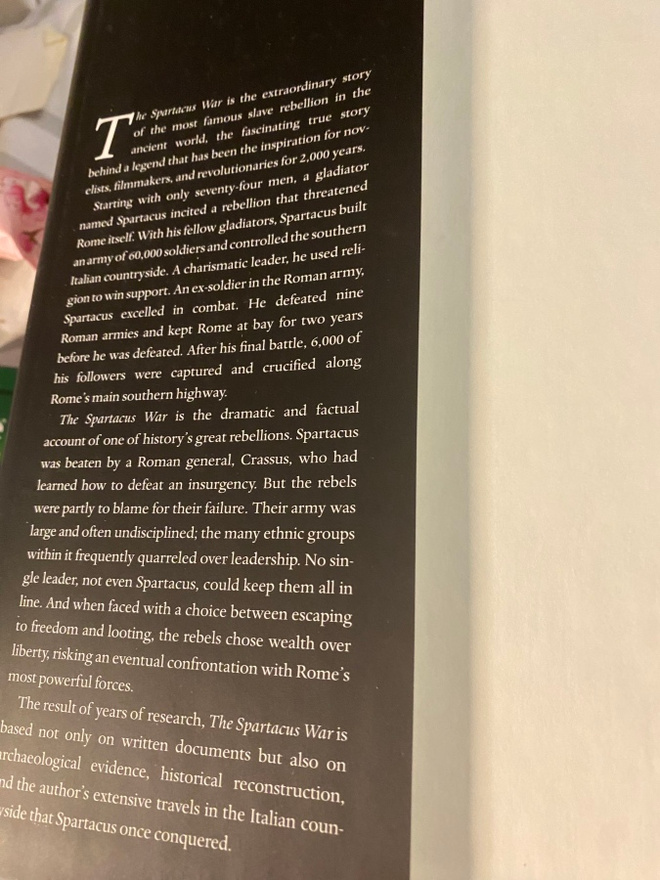
The Spartacus War is the extraordinary story of the most famous slave rebellion in the ancient world, the fascinating true story behind a legend that has been the inspiration for novelists, filmmakers, and revolutionaries for 2,000 years. Starting with only seventy-four men, a gladiator named Spartacus incited a rebellion that threatened Rome itself. With his fellow gladiators, Spartacus built an army of 60,000 soldiers and controlled the southern Italian countryside. A charismatic leader, he used religion to win support. An ex-soldier in the Roman army, Spartacus excelled in combat. He defeated nine Roman armies and kept Rome at bay for two years before he was defeated. After his final battle, 6,000 of his followers were captured and crucified along Rome's main southern highway.
The Spartacus War is the dramatic and factual account of one of history's great rebellions. Spartacus was beaten by a Roman general, Crassus, who had learned how to defeat an insurgency. But the rebels were partly to blame for their failure. Their army was large and often undisciplined; the many ethnic groups within it frequently quarreled over leadership. No single leader, not even Spartacus, could keep them all in line. And when faced with a choice between escaping to freedom and looting, the rebels chose wealth over liberty, risking an eventual confrontation with Rome's most powerful forces.
The result of years of research, The Spartacus War is based not only on written documents but also on archaeological evidence, historical reconstruction, and the author's extensive travels in the Italian countryside that Spartacus once conquered.
From Booklist
The first-century BCE slave revolt against Rome was led by Spartacus, a Thracian-born gladiator who had previously served as a Roman auxiliary soldier. Spartacus and the struggle he led have served as the inspiration for movies, an opera, and several fictionalized accounts. He has also been adopted as a symbol of freedom by political movements of both the Left and Right. Yet the historical Spartacus remains a murky figure, while the details of the revolt remain subjects of historical dispute. Strauss, professor of history and classics at Cornell University, has made an admirable attempt to fill in some of the gaps in the historical record in a compelling but highly speculative effort. Strauss admits the lack of reliable primary sources has forced him to engage in some tricky conjectures regarding the character and motivation of Spartacus. Still, many of his assertions are credible, and his efforts to portray the political and social milieu of Italy during the late Republic are superbly done. Strauss sees Spartacus as a brave and charismatic leader who was limited by some personal shortcomings. --Jay Freeman
Review
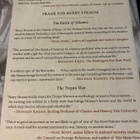
"With his trademarks of extensive knowledge, insight, and great storytelling ability, Barry Strauss brings us as close as we can get to the enigmatic Spartacus, the slave who defied the Roman Republic." -- Adrian Goldsworthy, author of Caesar: Life of a Colossus
About the Author
Barry Strauss, professor of history and classics at Cornell University, is a leading expert on ancient military history. He has written or edited several books, including The Battle of Salamis, The Trojan War, The Spartacus War, Masters of Command, The Death of Caesar, and Ten Caesars. Visit BarryStrauss.com.
From The Washington Post
From The Washington Post's Book World/washingtonpost.com One of the frustrations of studying the last agonized century of the Roman Republic is that our sources invariably derive from the ruling elite. No snob like a senatorial snob: To search the writings of authors such as Cicero or Sallust for details of how the lower classes lived is like panning for gold. Most despised of all -- and most ignored, of course -- were the slaves. It was certainly no concern of a Roman aristocrat's to examine the lives of those millions of unfortunates upon whose bent backs the entire glittering edifice of classical civilization had been raised. Yet one of those same unfortunates remains to this day a household name whose fame outshines that of many a senatorial high-flyer. After all, it was not Pompey, nor Cicero, nor even Julius Caesar who ended up being played on the big screen by Kirk Douglas, but the lowest of the Roman low: a gladiator. What makes this all the more extraordinary is that Spartacus himself, the slave who defied an empire, left no testimony of his own. The few fragmentary accounts of his life that do survive were composed by authors in whom the very thought of a slave rebellion inspired horror and contempt. From them we know the basic details of Spartacus's career: how he was brought from Thrace to fight in an arena in the shadow of Mt. Vesuvius; how he and about 70 other gladiators, armed only with kitchen utensils, broke out of their barracks; how for two years, from 73 to 71 B.C., his growing band of runaway slaves ravaged Italy; how at one point he led more than 100,000 men. And yet, despite the terror he inspired, there was a quality to Spartacus that even the Romans seem sneakingly to have admired. Whether it was overpowering his guards or putting consuls to flight or killing his horse to deprive himself of any means of flight when he finally faced defeat, he lived "fortissime" -- as a man of exceptional courage. The very features that so appealed to Hollywood, however, make Spartacus a potentially treacherous subject for any classicist. Historians, no matter how seduced by the drama of his revolt, are more circumscribed than their scriptwriting counterparts by the moth-eaten character of our sources. The balance between accessibility and scholarship, imagination and responsibility, is not always an easy one to strike. In his previous book on the Trojan War, Barry Strauss, a professor of classics at Cornell, seemed so desperate not to bore readers that he occasionally floated free of scholarly moorings. "The Spartacus War," however, has all the excitement of a thriller but none of the poetic license. Whether it is the remains of a trench system in the toe of Italy or an abandoned silver ladle or the mention of one of Spartacus's guides in "one line in a lost history book," Strauss makes every last scrap of information count. This is particularly the case when it comes to descriptions of fighting. The account of what it meant to be a gladiator, of the tactics required to be victorious and of the agony of defeat is particularly adrenaline-fueled. Spartacus's death -- not on a cross, as in Stanley Kubrick's 1960 movie, but charging the Roman general who led the campaign against him -- comes as a worthy climax to an epic that never once relaxes its tension. As to the broader question of what Spartacus was fighting for, whether a principled love of freedom or a bandit's love of plunder, Strauss hedges his bets. The goals of the rebellion, he concludes, were both noble and coarsely pragmatic: "honor, prowess, vengeance, loot, and even the favor of the gods." If so, then one of the reasons why Spartacus endured so long in the memories of the Romans must surely have been that he reminded them of themselves. Certainly, as Strauss points out, it was never a part of the rebels' manifesto to abolish slavery itself. What they objected to was not the institution, but their own entrapment within it. Marauding up and down Italy, they lived precisely as their former masters did: off the labor and produce of others. That notwithstanding, Spartacus does appear to have held some authentically exceptional principles. Uniquely among the leaders of slave revolts in the ancient world, he seems -- if we can trust our sources -- to have put his faith in something like an ideal of equality. For that reason alone, it might be argued, he more than merits this fine biography. As another, if less well historically attested, gladiator put it: "Brothers, what we do in life echoes in eternity."