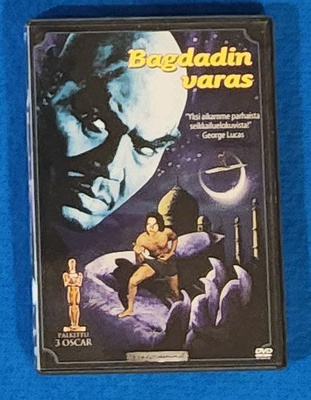
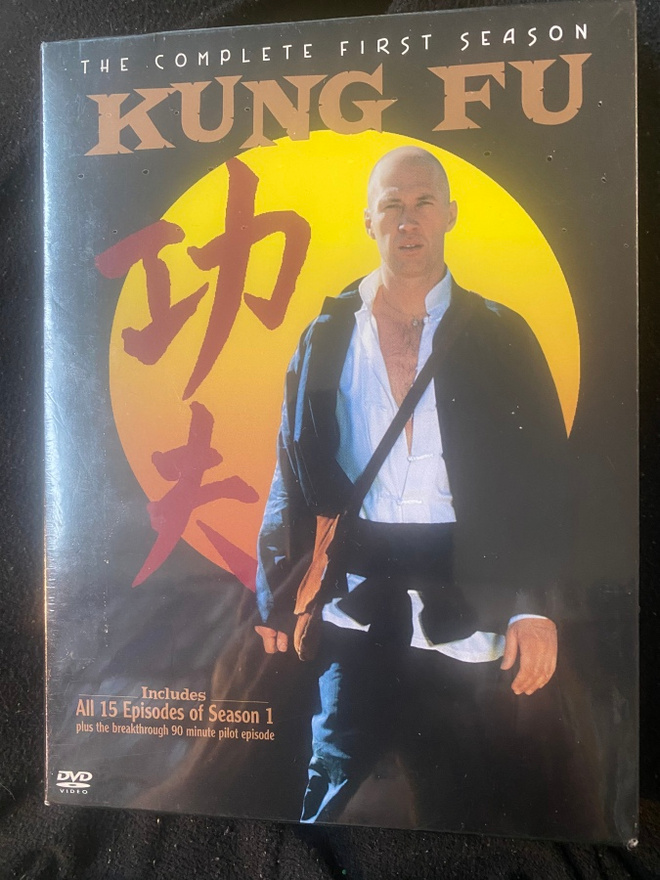
Kung Fu - 1. kausi 1972-73 UUSI R1
Kuvaus
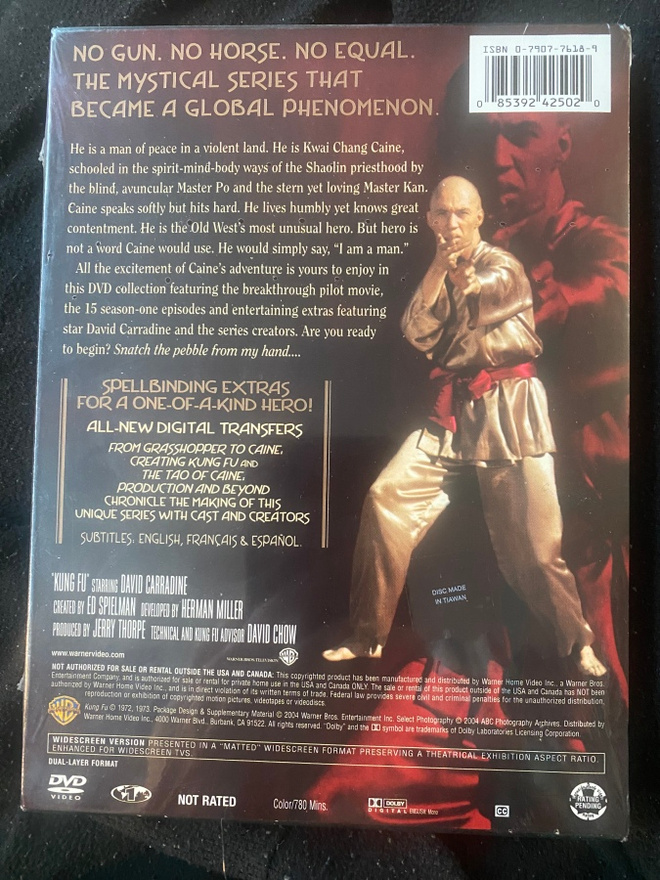
Ykkösalueen dvd-boksi legendaarisesta TV-sarjasta, pääosassa David Carradine. Uusi ja muoveissa.
Alun perin Bruce Leen ideoima, mutta sitten tapahtui kaikenlaista. Kontroverssin kulku Wikipedian mukaan: Casting controversy edit Kung Fu has been called an example of yellowface and a prominent case of whitewashing.[90] Most of the controversy lies in the allegation that the series' idea was stolen from Bruce Lee, but also in the fact that he was not cast for the leading role, and that decision had racial connotations. The "steal" theory has become widespread, both in academia[91][92] and in the media, even internationally.[93][94] The casting for the leading role when the project was still a feature film had considered (among others) James Coburn, who was preferred by Ed Spielman. When the script became an ABC Movie of the Week, the casting process considered (among others) Bruce Lee, Mako, and George Takei. After having "sought every Asian in Hollywood, because you didn't have to be super bright to know what was coming," and found none that could carry the series, they turned to the American side of the character and began auditioning white actors, including William Smith[95] and John Saxon.[96] Just two weeks before the pilot's filming started, David Carradine obtained the role at his second audition.[74] At the time, George Takei and the Association of Asian Pacific American Artists (AAPAA) filed a formal complaint for unfair hiring practices. They wanted an Asian actor in the leading role and a Chinese historical advisor; only the second demand was conceded. The Asian acting community was initially displeased, but with so few opportunities for Asian actors at the time, many felt it was better to have a successful show that could be a steady source of work for them in secondary roles than having none at all. Actor James Hong (who was the AAPAA's president), said: "As the show went on, we realized it was a great source of employment for the Asian acting community."[81] Representation of women and ethnic groups edit The series has been considered a commentary on race relations in the 1970s, both for its casting as for the depiction of discrimination against minorities.[97] It is noteworthy that race issues also affected the casting of secondary characters whereas gender inequality showed in their stories. France Nuyen and Nancy Kwan, both Eurasian, played Chinese characters, the first one accepting being given in marriage as payment for service her husband was hired to perform (s3e3), the other one preferring to be a concubine to the emperor rather than the wife of the warlord who had raped her, who was played by Stefan Gierasch, wearing prosthetic makeup (s2e22–23). Barbara Hershey appeared as a Eurasian woman who flees forced marriage to a warlord played by Khigh Dhiegh (born Kenneth Dickerson), and is denied admission to the Shaolin temple as a student because "You are female – You are also of mixed blood" (s3e10–11). On the other hand, American women are sometimes portrayed as dependant or even unable to survive without men (s1e14, s2e16, s3e4), but also as independent individuals, like entrepreneurs (s3e23), landowners (s2e14, s3e1–2), ranchers (s2e12, s3e3) or craftswomen (s1e3), according to the feminist currents of the time. Notably, Asian women are portrayed that way on occasion (s1e5, s1e8), and not just in stereotypical or subservient roles. Given that the series' action happens mostly in the 19th century California, black people appear as important characters in just a few episodes (s1e13, s2e1, s2e16, s3e18, s3e24), as at the time they were a small portion of the state's population, yet all of the episodes have to do with them facing discrimination. Interestingly, when the consequences of the American Civil War are mentioned, they are in the context of defeat and vengeance (s1e4, s2e3, s3e24), not of the abolition of slavery. Regarding Native Americans, as it was usual at the time, they are mostly portrayed by non-Native actors, usually from the Hispanic community and also by Whites (s2e6), whereas the Hispanics themselves appear mostly when Caine visits towns in New Mexico or Mexico (s2e3, s2e4, s3e14), even if at the time there was an important Hispanic presence in the state. The portrayal of Native Americans varies from the stereotypical faceless villains (s1e1, s1e2), to objects of persecution and discrimination (s2e5, s3e5) to a co-leading character in the s1e15 episode "The Ancient Warrior," the only one with a Native actor billed in the opening credits, which precisely deals with the extermination of a whole tribe. The absence of Native actors and the cultural misrepresentation issue wasn't unique to this series nor to its time; it has led the National Congress of American Indians to pass a resolution on the subject as recently as 2017.[98] Representation of Asians edit East Asian, or rather Chinese portrayal in the series remains a problematic subject. Academic studies tend to mention the show in the context of discrimination against Asians in American society and entertainment. Professor Jun Xing (Chun Hsing in Library of Congress' cataloging)[99] states that segregating actors by roles seems reasonable when ethnic characters are cast, but there is a double standard in which Asians cannot play roles designated as White, whereas Caucasian actors cross into ones representing every other race, showing that in movies American people are not every color, but Black and White. Also, as there is an East–West dichotomy; Asians are not seen as Americans. With that in mind, to maintain the double standard, "Eurasian characters have become Hollywood's favorite creations. These mixed-race characters obviously allow white actors and actresses, with minimum makeup, to steal major roles from Asians." And puts Kung Fu as the "best example" of that, noting Bruce Lee's involvement.[100] Professor Hye Seung Chung[101] exemplifies Asian representation in American film and television, and the roles Asian actors were allowed to play, with the case of Philip Ahn, who, being the son of a Korean national hero, spent his career playing minor and secondary characters, usually Japanese and Chinese. On page 31, she compares a letter from an admirer of Ahn's work as Master Kan with playwright Frank Chin's attack on the series in a 1974 The New York Times article, when he states that apes' roles in movies had evolved better than Chinese images in media. Even if Professor Chung states on page 177 that "Kung Fu was a groundbreaking series produced by Warner Bros. that intermixed the martial arts genre with Wild West iconography, expanding the syntax of the television western to accommodate "foreign" elements at the scenographic and narrative levels," her analysis decries the way the Kan character is depicted as "emasculated," stereotyped in various ways, and she mentions that Bruce Lee was not cast in the leading role.[102] Also, the series itself lacks historical and cultural accuracy in this matter. Through the episodes, the writers made mistakes regarding the order of Chinese names, and about who was the Emperor in China at the series' time period. When Japanese elements appear, they are unlikely to be known or happen at the said time: in s3e12, the boy Caine watches a Noh performance in a mandarin's mansion, when Japan was still an isolationist country. In s2e2, among three Japanese characters, there is a woman who has been married to an Englishman for over 15 years, when British subjects had been allowed to reside in Japan only since 1862–1863; also Caine knows well what a ninja is, just ten years after Japan's opening to international relations. Most importantly, the series' Shaolin priests teach Taoist and Confucian philosophy, whereas the actual Shaolin monks are Buddhist. However, the absence of allusions to Joseon Korea is correct, as immigrants from that kingdom arrived in America after 1884. Another issue that has come under the scrutiny of academia and the media, which is not exclusive to this series, is the fact that Asian actors of several nationalities and ethnicities appeared in the Kung Fu main or guest cast playing Chinese characters, "interchangeably". Professor Chung on page 16-17 exemplifies this situation that Asian actors in the American entertainment industry face with the careers of two Kung Fu cast members, Philip Ahn (Korean) and Richard Loo (Hawaii-born Chinese American) who so often played Japanese villains in war movies that international magazine articles about them confused their pictures: "This confusion speaks to the interchangeability of Asian actors, regardless of nationality and ethnicity, which was fostered by an industry insensitive to the diversities and differences within the same racial group." In an early article about the series, both actors are referred to and they call their characters "Orientals".[30] Professors Kent A. Ono and Vincent N. Pham call that perceived interchangeability "implicit yellowface".[103] It is a problem that, together with whitewashing has continued into present times and is noticed internationally.[104][105][106] Regarding this "interchangeability" issue, given the historic period in which Kung Fu is set, Koreans couldn't have appeared, and Japanese perhaps shouldn't have, as in the 1870s' America there were just 55 Japanese immigrants registered. Yet in the episode s2e2 it is established through dialogue, costume, and cultural details that the Japanese are not the same as Chinese, and they are played by actors of Japanese ancestry. Radames Pera, who played young Caine, mentioned in 2021, "They did the best they could at the time...They were taking heat from the Asian community from the onset. So they actually made a deal with some of the representatives from Asian American community to hire everybody in town, whether they were Korean, Japanese, Chinese, or Filipino who had a SAG card. They also gave cards to those who didn't have one by giving them their first job in a union production. Literally every Asian actor in town worked on that show."[107] Recapitulation edit "'That guy is me,' Spielman says. 'That Caine character is me in a way, just like Siegel and Shuster did Superman. He was always Eurasian; he always didn't fit in.'" So, according to its creator, it was not a maneuver that would make it fit for a White actor, even if his first choice for the role had been James Coburn. Regarding the casting process, the production team says they did try to cast an Asian actor but none was adequate for the role, including Bruce Lee. John Furia Jr. asserted that "the concept of the series was a man who was not involved, a man who avoided action at almost any cost, a very quiet, seemingly passive man." Tom Kuhn, besides claiming that Lee's speech was hard to understand, said: "It did occur to me that this part was rather cerebral, a guy who only fights when he's absolutely cornered." Even Fred Weintraub, who had lobbied for Lee since the beginning, noted that they needed an actor "to portray the sense of quiet serenity that Caine possessed, a quality that driven and intense Bruce was not known for." Still, both Kuhn and Weintraub admitted that "the powers that be" were unwilling to hire an Asian actor per se.[74] Academic studies about Asian representation in American entertainment claim that the casting of the leading role and even the portrayal of the Chinese characters by Asian actors followed generalized discriminatory patterns. Put in a historical context in which White actors were free to play Asian, Eurasian and other ethnicities' roles, whereas Asian, Eurasian and mixed-race actors played the stereotypical Asian roles left but never White roles, anti-miscegenation laws had been repealed just in 1967, the Hays Code finally abandoned in 1968, and whitewashing has continued into the 21st century, their authors simply can't believe that the casting of a White actor for a Eurasian role in 1971 could have had any other cause than inveterate racism, much less when Bruce Lee was involved.[103][108][109] The media continues to list this show as racist, not for its contents but because future star Bruce Lee wasn't cast in a role that perhaps wasn't suited for him, as an actor, in November–December 1971, and because of the rooted belief that the idea for the series was "stolen" from him.[110][111][112] In consequence, the new show takes the name of the original one while completely separating itself from it,[11][113][114] instead of continuing its story or attempting to build upon its legacy, claiming with good reason that their aim is improving Asian community's representation and visibility.[115][116][117] Interestingly, in the s1e3 episode "Blood Brother," Kwai Chang Caine pleads for his compatriots to do that, as a matter of life and death. (Caine has uncovered a hate crime against an old condisciple. An inquest ensues, which could lead to a possible, but unlikely indictment. Caine urges a Chinese man who has been assaulted by the murderers to present himself at the proceeding.) "Have you learned nothing?" "You are new to this country. You must understand. No jury will indict a white man for what has been done to one of our people." "Yet you must appear... If you stay away, it will be an acceptance of things as they are. If you appear at the inquest your very presence will be a demand for justice. The presence of your son, your wife, and your daughter, will be worth even more." "You ask me to subject my family to shame? To hurt? For what reason?" "How can they find safety in a fortress whose walls will burn; whose windows cannot stop a bullet; whose doors will yield to anyone with the strength to force them? How can you hide, when the more you remain unseen, the more they will feel free to seek you out?" Placed in a turning point of the history of American society and television, being the last show in American television with a leading character in yellowface, obscures what the show did accomplish. In a time when Asian actors were largely ignored, and usually played minor and openly stereotypical roles, Kung Fu was exceptional for consistently presenting them as not stereotypical characters and for being a steady job source for Asian actors, which was acknowledged by members of the cast[30] and the AAPAA's president James Hong. The episodes s3e8, s3e10–11, s3e15 and s3e22, set in China, had a mostly Asian American cast. Also, the show was clear in denouncing anti-Chinese racism, including hate crimes (s1e3), and pointed at historical events ignored in popular culture, like the Page Act of 1875 that basically forbade the immigration of East Asian women (s1e8), or the harsh labor conditions of the Chinese immigrants who built the transcontinental railroad (pilot, s3e9). Despite its historical inaccuracies, the series' dialogue was greatly based on Chinese philosophy, which gave viewers an introduction to its spiritual values, and its dramatic appeal made it the recipient of international accolades. Episodes Reception edit Critical response edit Rotten Tomatoes calls the series "influential",[118] and Metacritic in describing it says: "A man of peace, though trained to defend himself, Caine always made an attempt to address situations in a way that was morally acceptable to his beliefs, and to resolve them through [the] least violent means possible. His journey is not only one across the frontier of America but one through the light and dark areas of the soul as well."[119] In a May 1973 Black Belt magazine interview with John Furia Jr., the author Jon Shirota speaks about the critical response in these terms: "Even the TV critics, customarily very reserved and cautious with their appraisals, acclaimed the show [the first segment] as one of the year's best. (...) One critic wrote that the success of Kung-Fu may be attributed to the very thing the producers were afraid of: the public's not knowing what the series was about. 'Actually,' said the critic, 'it adds a certain amount of unpredictability and suspense to the plot. It is unlike most of the western heroes whose faces are like the book you've already read.' Another critic said that a story like Kung-Fu could never have been made into a movie 10 years ago because no one would have cared about a bunch of coolies. 'It is only now,' he quipped, 'that we are giving true credit to history.'"[13]