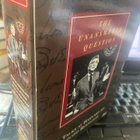
Leonard Bernstein: The Unanswered Questions 6dvd


Osta heti
Sulkeutuu: 119pv 22h44,00 €
Kuvaus
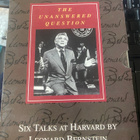
Leonard Bernsteinin legendaariset Harvard-luennot klassisen musiikin aineksista, olenuksesta ja filosofiasta. Vaativaa kuultavaa. yli 13 tunnin urakka. 1. alueen dvd.
Always absorbing and frequently brilliant, Leonard Bernstein's The Unanswered Question is a very lucid and convincing discussion of music's history and forms, with particular emphasis on modern music. It addresses the average intelligent listener who is not musically trained but wants to know what makes music work--what is meant, for example, by "tonal" and "atonal." It requires some concentration, but Bernstein, a superb teacher, keeps technical jargon to a minimum, illustrates what he means with musical examples and graphics, and repeats key points.
Delivered in 1973, the talks were transcribed for a book, but in it Bernstein insists "The pages that follow were written not to be read, but listened to," really an endorsement of the video edition. The talks are, in fact, performances. Television was always kind to Bernstein; he had magnetism and knew how to use it. To illustrate various points in his analyses, he plays the piano frequently, sings occasionally, and conducts significant works of key composers: Mozart, Beethoven, Berlioz, Wagner, Ravel, Debussy, Ives, Mahler, and Stravinsky.
Bernstein traces the development of music from its origins to the 20th-century struggle between tonality (championed notably by Stravinsky) and atonalism (represented mainly by Schoenberg). The last two talks, devoted to these composers, are particularly enlightening, but all six are outstanding. He argues persuasively that humans are born with an ability to grasp musical forms, and that rules of musical syntax are rooted in nature--in mathematically measurable relations between tones and overtones.
These talks are a key document. They coincide chronologically, as cause and/or symptom, with the movement of America's leading composers back from Schoenbergian forms toward a tonal orientation. Bernstein predicts and promotes this movement, which is still in progress. He is clearly an advocate of tonality, but he discusses atonal music with sympathy and understanding. --Joe McLellan
Product description
This amazing 6 volume DVD explores all types of music, including: folk music, pop songs, symphonies, tonal and atonal works; all taught by legendary master composer and conductor, Leonard Bernstein.
From the Back Cover
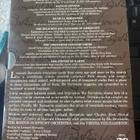
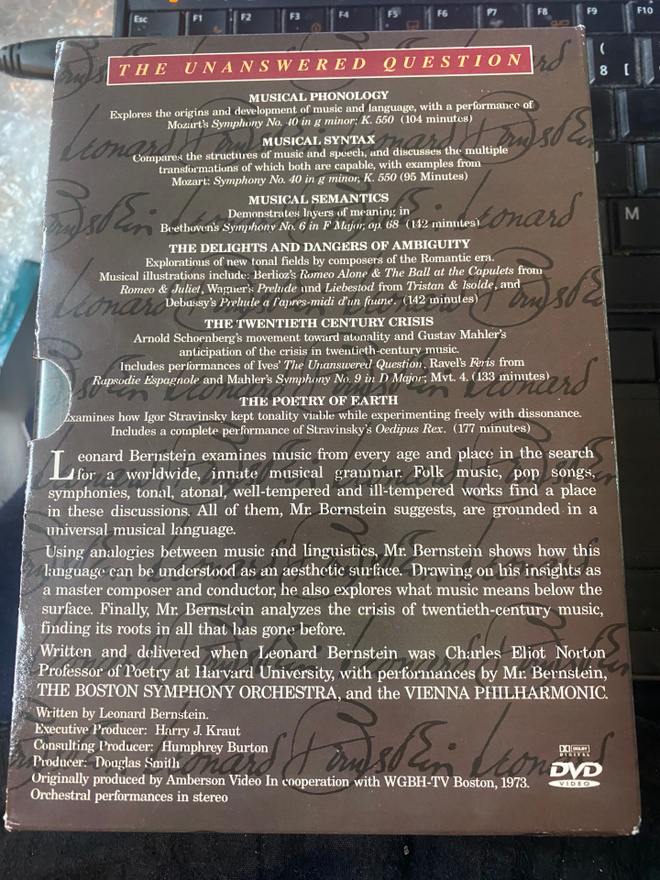
Leonard Bernstein examines music from every age and place in the search for a worldwide, innate musical grammar. Folk music, pop songs, symphonies, tonal, atonal, well-tempered and ill-tempered works find a place in these discussions. All of them, Mr. Bernstein suggests, are grounded in a universal musical language. Using analogies between music and linguistics, Mr. Bernstein shows how this language can be understood as an aesthetic surface. Drawing on his insights as a master composer and conductor, he also explores what music means below the surface. Finally, Mr. Bernstein analyzes the crisis of twentieth-century music, finding its roots in all that has gone before. Written and delivered in 1973 when Leonard Bernstein was Charles Eliot Norton Professor of Poetry at Harvard University, with performances by Mr. Bernstein, the Boston Symphony Orchestra, and the Vienna Philharmonic. 780 minutes.
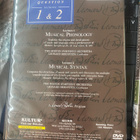
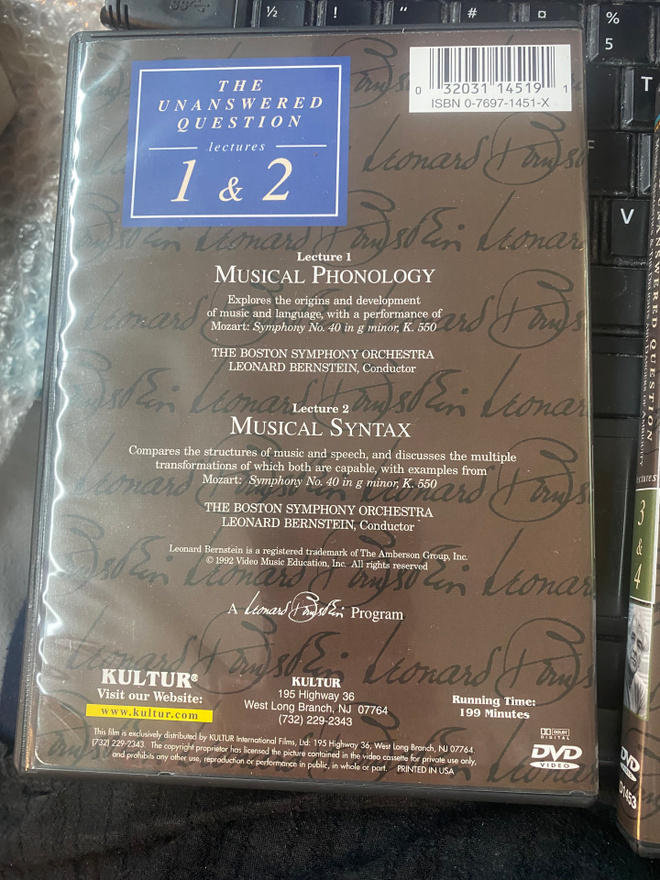
Musical Phonology: Explores the origins and development of music and language, with a performance of Mozart's Symphony No. 40 in G minor, K. 550. 104 minutes.
Musical Syntax: Compares the structures of music and speech, and discusses the multiple transformations of which both are capable, with examples from Mozart's Symphony No. 40 in G minor, K. 550. 95 minutes.
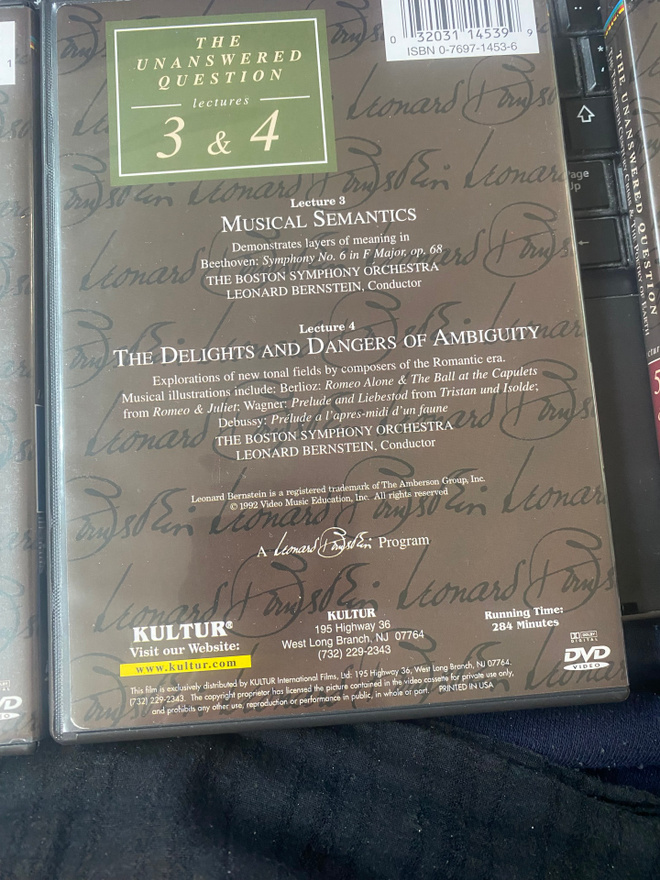
Musical Semantics: Demonstrates layers of meaning in Beethoven's Symphony No. 6 in F Major, Op. 68. 142 minutes.
The Delights and Dangers of Ambiguity:Explorations of new tonal fields by composers of the Romantic era. Musical illustrations include: Berlioz's "Romeo Alone" and "The Ball at the Capulets" from Romeo & Juliet, Wagner's "Prelude und Liebestod" from Tristan & Isolde, and Debussy's Prelude a l'apres-midi d'un faune. 142 minutes.
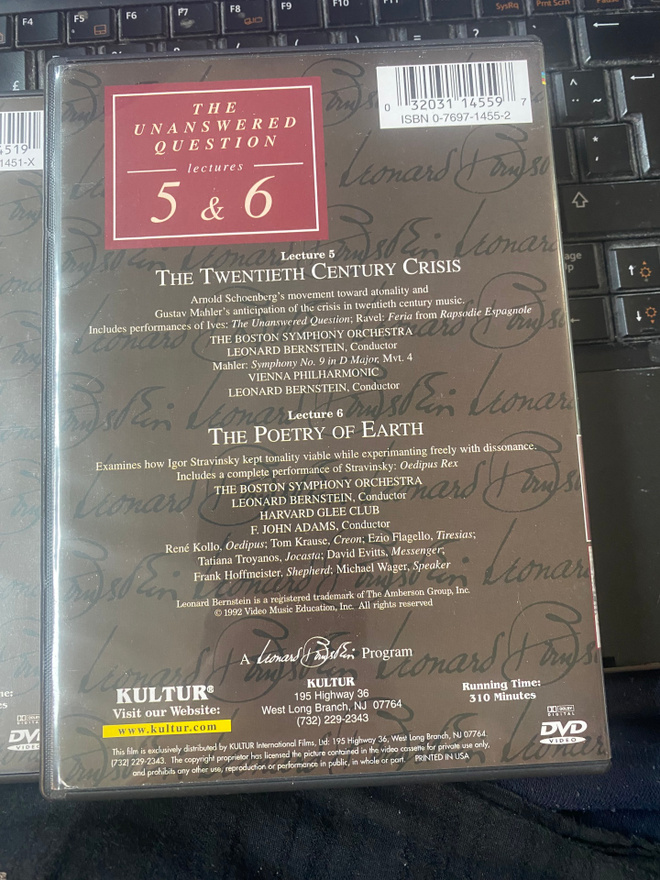
The Twentieth Century Crisis: Arnold Schoenberg's movement toward atonality and Gustav Mahler's anticipation of the crisis in twentieth-century music. Includes performances of Ives's The Unanswered Question, Ravel's "Feris" from Rapsodie Espagnole, and Mahler's Symphony No. 9 in D major, mvmt 4. 133 minutes.
The Poetry of Earth: Examines how Igor Stravinsky kept tonality viable while experimenting freely with dissonance. Includes a complete performance of Stravinsky's Oedipus Rex. 177 minutes.
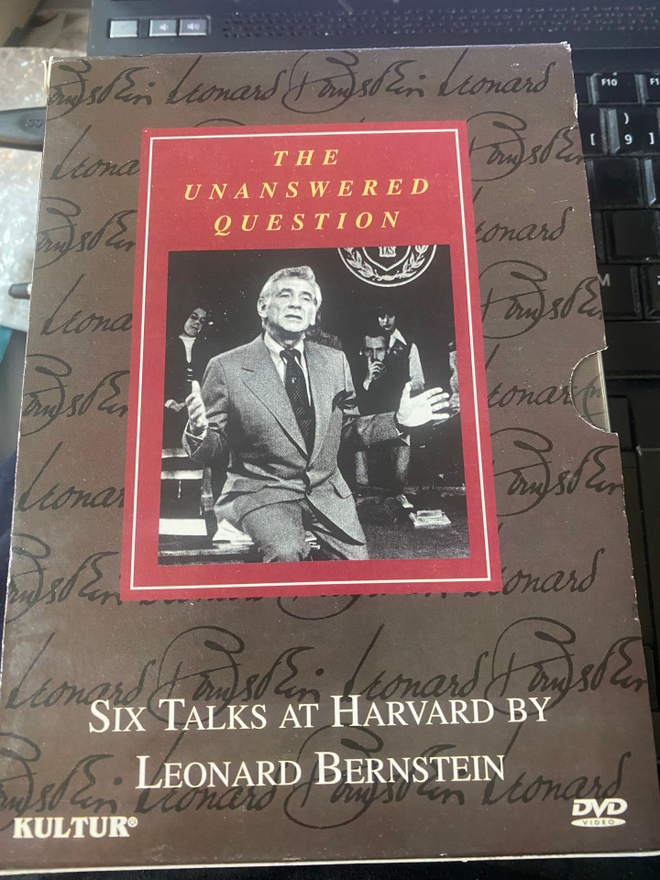
The Unanswered Question: Six Talks at Harvard is a 6-DVD box set featuring legendary composer and conductor Leonard Bernstein delivering his famous 1973 Charles Eliot Norton Lectures. Spanning roughly 13 hours, the series uses linguistics and musical examples to explore a universal grammar of music.
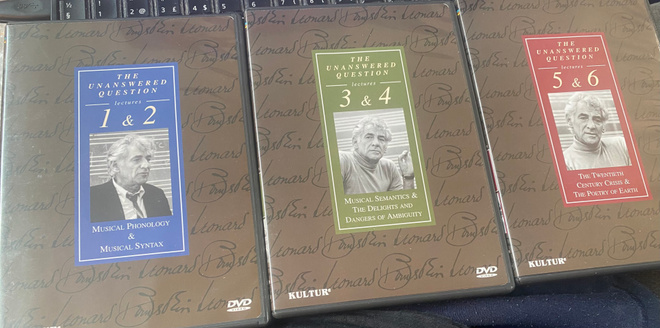
The Six Lectures on DVD
Musical Phonology: Explores music as a language using linguistic analogies.
Musical Syntax: Investigates symmetry, musical physics, and harmonic series.
Musical Semantics: Looks at how music communicates meaning without words.
The Delights and Dangers of Ambiguity: Examines musical vagueness, heavily featuring Gustav Mahler.
The Twentieth Century Crisis: Analyzes the breakdown of tonality and the rise of atonal music.
The Poetry of Earth: Looks ahead to the future of music in a modern age.
Availability and Release Details
Format: 6-disc DVD set (released by Kultur).
Origin: Filmed during Bernstein's 1972–1973 Harvard residency and broadcast on PBS.
BBC Music Magazinen arvostelu:
The Unanswered Question - Six Talks at Harvard by Leonard Bernstein
Ever the chameleon, Leonard Bernstein — pianist, composer, conductor, Broadway hero — turned academic in 1972-3 when he took up the prestigious Charles Eliot Norton visiting chair at Harvard. His series of six public lectures which formed part of the residency took its title from Ives's The Unanswered Question, which, to Bernstein, asked: 'Whither music in our time?'
Published: January 20, 2012 at 6:20 pm
COMPOSERS: Bernstein
LABELS: Kultur
PERFORMER: Leonard Bernstein
CATALOGUE NO: D 1570 (distr. + l 800573 3782; www.kultur.com)
Ever the chameleon, Leonard Bernstein — pianist, composer, conductor, Broadway hero — turned academic in 1972-3 when he took up the prestigious Charles Eliot Norton visiting chair at Harvard. His series of six public lectures which formed part of the residency took its title from Ives's The Unanswered Question, which, to Bernstein, asked: 'Whither music in our time?'
Drawing on Noam Chomsky's Language and Mind(1969), arguing for an innate human competence for grammar, Bernstein set himself on a line of musico-linguistic enquiry, a path genuinely novel at the time, that embraced not only music and linguistics, but literature, aesthetics, philosophy and logic.
In the first three lectures Bernstein presents his concepts of musical phonology (units of material), syntax (structure) and semantics (meaning). He postulates bold parallels between music and language — phrase=word, motive=noun, harmony=adjective — and pursues these ideas tenaciously if ultimately unconvincingly.
The last three lectures extend the idea of meaning: the fourth focuses on harmonic ambiguity in Berlioz, Wagner and Debussy — offering fascinating insights into the Very many borrowings from Berlioz's Romeo et Juliette in Wagner's Tristan — while in the fifth and sixth Bernstein considers Schoenberg and Stravinsky, the composers set up by Adorno as representing opposing poles on the axis of modern music.
After a brilliant introduction to the 12-note system, Bernstein argues that it was condemned never to achieve true atonality — shackled as it was to the same 12 notes that carry inherent harmonic suggestion — and goes on in the last lecture to examine at length Stravinsky's asymmetry and neo-classicism, all illuminated with numerous examples at the piano.
Supporting his theses are specially recorded performances mostly by the Boston Symphony, in which he conducts Mozart's Jupiter Symphony, Beethoven's Pastoral Symphony, Wagners Prelude and Liebestod from Tristan, Ravel's Rapsodie espagnole, the finale from Mahler's Ninth Sympony and a semi-staging of Stravinsky's Oedipus rex— some of which receive detailed and fascinating introductory analysis from Bernstein at the piano.
From a theoretical viewpoint Bernstein presents a far from watertight thesis — though he undoubtedly contributed to opening up a new field of study, formalised by Lerdahl and Jackendoff "s Generative Theory of Tonal Music (1981).
The main value for the general listener lies in Bernstein's fertile mind, which forms a vast network of musical and extra-musical associations, like a torchlight selectively illuminating the dark forest of musical history (Bernstein litters his own discourse with metaphor). But the series also offers an insight into Bernstein the man, revealing yet another aspect to his multi-faceted genius.