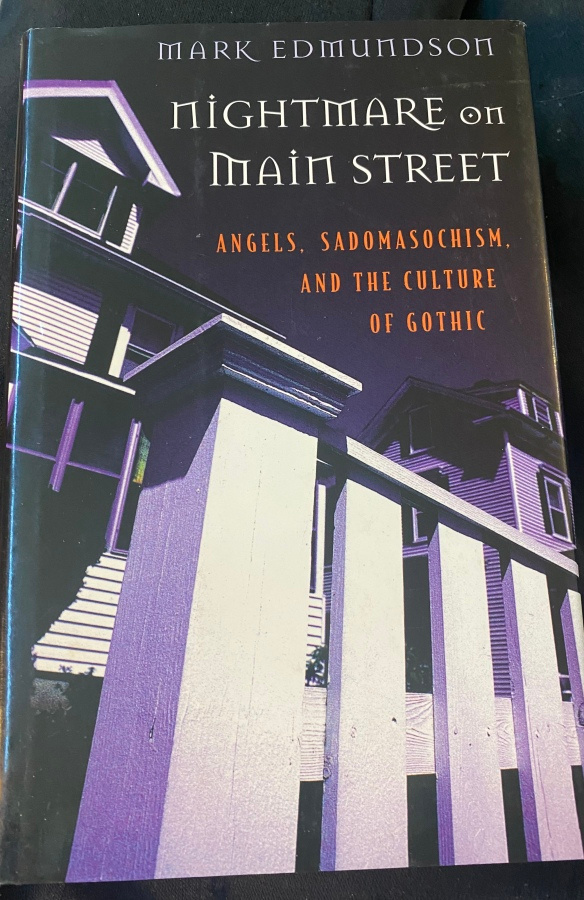
Nightmare on Main Street - Mark Edmunson

Osta heti
Sulkeutuu: 70pv 19h10,00 €
Kuvaus
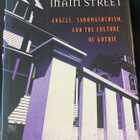
Alaotsikko: ”Angels, Sadomasochism and the Culture of Gothic”. Englanninkielisen kirjallisuuden professori sovittaa romantiikan ja goottilaisen sensibiliteetin teoriaa amerikkalaisen nykykulttuurin analyysiin. Esimerkit tulevat lähinnä kauhuelokuvista. Kovakantinen, Harvard 1997, 190 sivua. Alkupuolella kuulakärkikynällä merkintöjä.
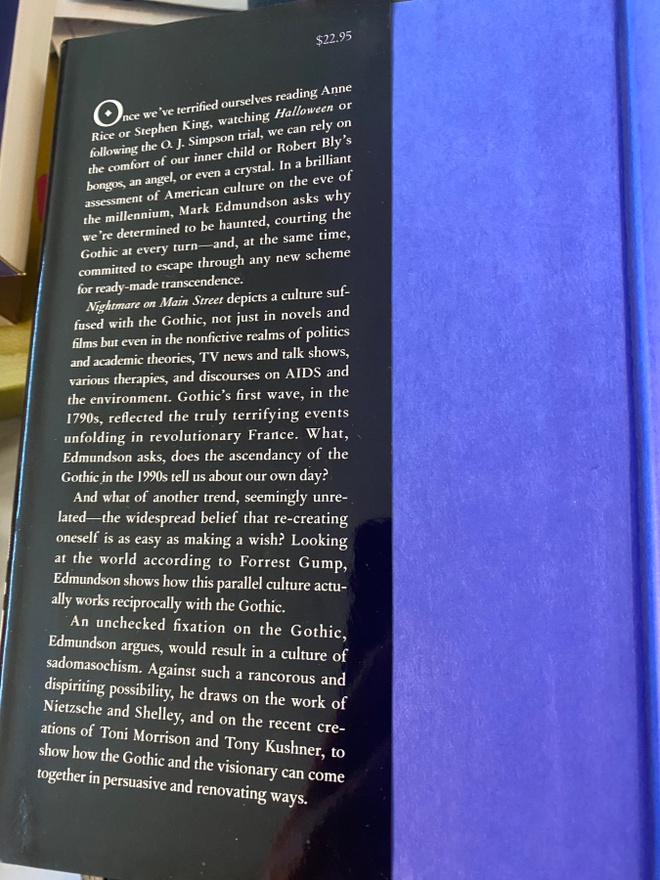
Once we've terrified ourselves reading Anne Rice or Stephen King, watching Halloween or following the O. J. Simpson trial, we can rely on the comfort of our inner child or Robert Bly's bongos, an angel, or even a crystal. In a brilliant assessment of American culture on the eve of the millennium, Mark Edmundson asks why we're determined to be haunted, courting the Gothic at every turn--and, at the same time, committed to escape through any new scheme for ready-made transcendence.
Nightmare on Main Street depicts a culture suffused with the Gothic, not just in novels and films but even in the nonfictive realms of politics and academic theories, TV news and talk shows, various therapies, and discourses on AIDS and the environment. Gothic's first wave, in the 1790s, reflected the truly terrifying events unfolding in revolutionary France. What, Edmundson asks, does the ascendancy of the Gothic in the 1990s tell us about our own day?
And what of another trend, seemingly unrelated--the widespread belief that re-creating oneself is as easy as making a wish? Looking at the world according to Forrest Gump, Edmundson shows how this parallel culture actually works reciprocally with the Gothic.
An unchecked fixation on the Gothic, Edmundson argues, would result in a culture of sadomasochism. Against such a rancorous and dispiriting possibility, he draws on the work of Nietzsche and Shelley, and on the recent creations of Toni Morrison and Tony Kushner, to show how the Gothic and the visionary can come together in persuasive and renovating ways.
Amazon.com Review
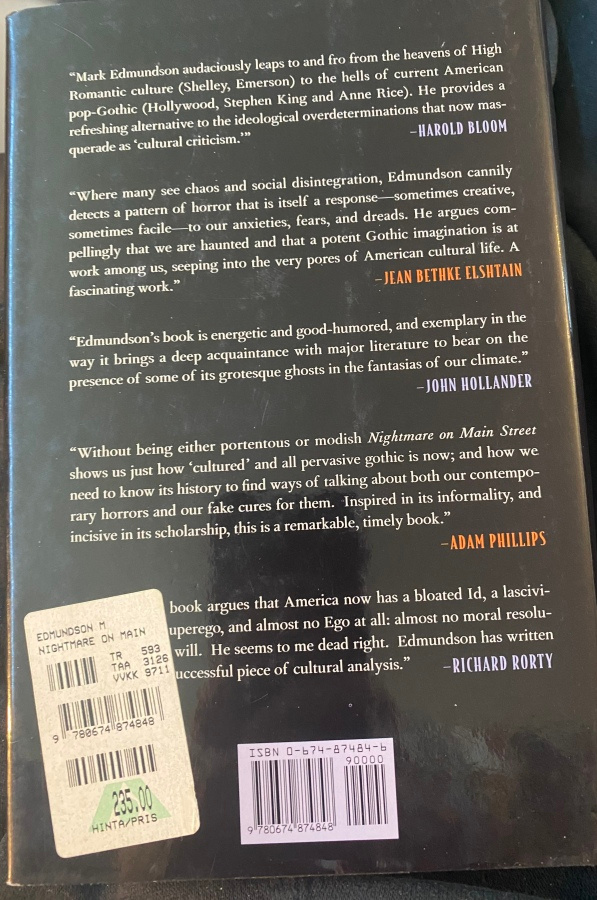
If you observe American pop culture, you'll recognize the questions Mark Edmundson raises in Nightmare on Main Street: Why are the 1990s seeing a resurgence of the gothic? Why do tabloid stories about people such as O. J. Simpson and Lorena Bobbitt captivate the public imagination? Why are "goth" fashions and music in vogue? Why is sadomasochistic sexuality on the rise? And what about the craze for what Edmundson calls "pop transcendence," the phony innocence exemplified by Forrest Gump, angels, and the inner child? Nightmare on Main Street is well written and accessible, and will be of interest to anyone appreciative of (or concerned about) horror books and movies. As Richard Rorty writes, "[This] book argues that America now has a bloated Id, a lascivious and cruel Superego, and almost no Ego at all: almost no moral resolution or political will." Edmundson's proposed solution is kind of vague, but he acknowledges the positive, creative role of horror: he proposes that we "take Gothic pessimism as a starting point and come up with visions that, while affirmative, never forget the authentic darkness that Gothic art discloses."
From Library Journal
Edmundson (English, Univ. of Virginia), who writes prolifically for both the "lit-crit" elite and the mass intelligentsia, here addresses neither literary historians nor "practitioners of...cultural studies." Yet because his work, however fun?horror literature and movies are, after all, created as entertainment?is still an academic product, he may fail to reach his intended audience. Any book that expects its readers to be breezily familiar with Prometheus, Foucault, Poe, and Freddy Krueger assumes a certain hipness rarely found beyond campus environs. The point of this disquisition is also obscure. While Edmundson backs up his basic observation that today's popular attraction to slasher flicks, tabloids, and O.J. Simpson true-life horror tales is similar to the Gothic phenomenon of the early 19th century, he never explains why he thinks the culture of Gothic flourished, then and now, and why it matters. Not recommended.?Scott H. Silverman, Bryn Mawr Coll. Lib., Pa.
Copyright 1997 Reed Business Information, Inc.
From Kirkus Reviews
What do Richard Nixon, Freddy Krueger, O.J. Simpson, and Edgar Allan Poe have in common with one another--but not with Percy Bysshe Shelley and Ralph Waldo Emerson? Answer: The former express our nation's cult of gothic guilt and fear; the latter are potential models of redemption. Edmundson (English/Univ. of Virginia) argues that the gothic mindset, exemplified in lurid classics of the late 18th century (e.g., Walpole's The Castle of Otranto and Lewis's The Monk) dominates contemporary American culture. From these works he distills categories that he finds ubiquitous in modern pop culture, including protagonists equally divided between good and wicked selves, scenarios in which dungeons or other underground scenes of sadomasochistic horror figure prominently, the hidden past that refuses to die (in recovered-memory syndrome), and so forth. Racism is, above all else, the part of the American past that refuses to die, haunting us in fiction (Toni Morrison's Beloved), in the news (O.J.), and in cinema. Edmundson has written an entertaining and thoughtful book, but his overly elastic thesis occasionally gets the better of his good judgment. He is prone to write outlandish things, making his book at times a lurid bit of American gothic itself. His arguments often fall into the categories he criticizes: Poe, for example, is Emerson's evil twin in the American tradition (his America seems divided between angels and incubi). Though he justifiably scorns the recent angel craze as an expression of phony transcendence, he also presents Shelley, Emerson, Whitman, and even Nietzsche as angels of a sort (he calls them ``visionaries'') who might deliver us from our abject need. One might say that this book's thesis belongs in the American tradition of cultural pessimism, the very malady for which it purports to be the cure. Even though Edmundson's main thesis is overdrawn, his book is rewarding. It has many startling insights, shrewd observations, and considerable narrative momentum. -- Copyright ©1997, Kirkus Associates, LP. All rights reserved.
Review
[A] compelling explanation of our ever more ghoulish obsessions. (Jeffrey Toobin The New Yorker)
One cannot but admire the forward pressure of the argument, the breadth of reference, the passion with which it is conducted, and, at times, the passages of analysis. (Francis Devlin-Glass Canadian Review of Literature)
In his provocative book about the Gothic, Mr. Edmundson notes that the genre flourished in the years after the French Revolution. Those drafty castles with their dark secrets, the vampirish counts and the leering clergymen were all embodiments of the ancient regime, the old feudal order haunting the unsteady world of the new. Modern innocents are lured into that realm and nearly overwhelmed by it, until they exorcise its demonic control. The past is finally passed. The disgusting is contained, controlled, overcome. But today, Mr. Edmundson argues there is no clear resolution to our Gothic tales. Their haunting addictions and demonic figures keep reappearing in rock videos, computer games, television talk shows and horror films. But the villainy is ambiguous...No sooner do we start to hate the wife abuser on a talk show than we learn that he too is a haunted victim of abuse or a recovering addict. We are all villains and all victims. (Edward Rothstein New York Times)
Absorbing...The Gothic thrives, Edmundson argues, in a world in which 'those in authority--the supposed exemplars of the good--are under suspicion,' a world in which cynicism ('the conviction that the worst truth that you can come up with about any person or event is the most consequential truth') is a given...Drawing upon his considerable knowledge of American and European literature, Edmundson does a nimble job of situating the current Gothic craze in context with philosophical developments, while at the same time assessing its social consequences...Nightmare on Main Street is a provocative and often illuminating book. (Michiko Kakutani New York Times)
Edmundson's book has a simple yet visionary thesis. America--the patient--is infected with a psychological virus that fosters a death-worshipping attitude toward existence...Edmundson's clarity of vision, airtight logic, and captivating prose...succeed in convincing the reader of his thesis...[He] is strongly conversant with classic Anglo-American literature, movies and television. Part of this book's intellectual charm is that he draws on such a heterogeneous range of supporting examples, from Oprah to Hitchcock, from Wordsworth to Robert Bly, from Wes Craven to Keats. (Paul Di Fillippo Washington Post Book World)
I never would have thought that Forrest Gump, Sigmund Freud and O.J. Simpson had anything to do with one another. But Mark Edmundson turns them into one big, dysfunctional family in his provocative new book about contemporary American culture...The strength of Edmundson's analysis is his ability to use the concept of the gothic sensibility to tie together seemingly disparate strands of contemporary culture and show how our view of reality is shaped by them...I suggest Nightmare on Main Street to readers who want to understand the stories America tells itself. (Greg Beatty News & Observer)
About the Author
Mark Edmundson is Professor of English at the University of Virginia. His books include Literature against Philosophy, Plato to Derrida; and Wild Orchids and Trotsky.