Stephen J. Gould: The Structure of Evolutionary Theory
Osta heti
Sulkeutuu: 64pv 6h30,00 €
Kuvaus
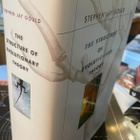
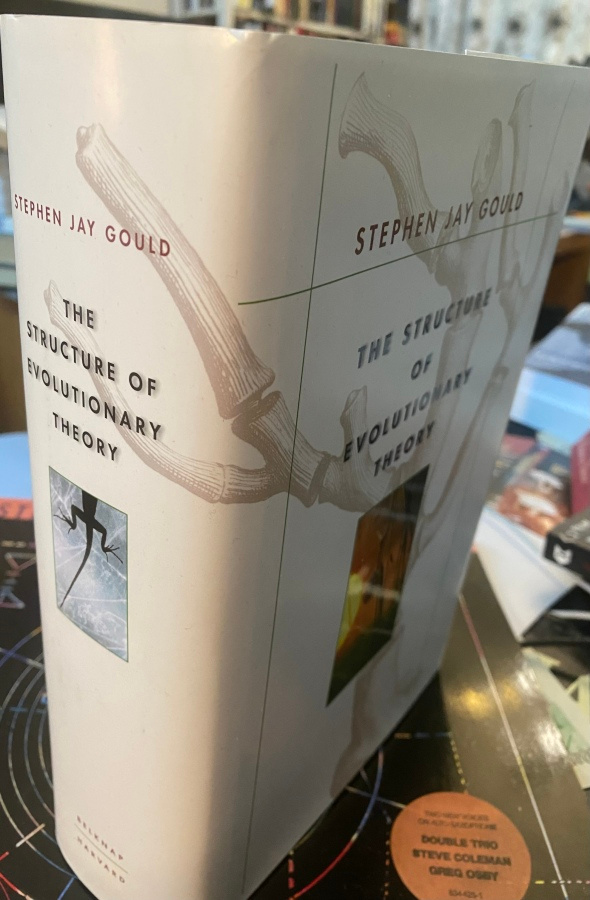
Yksi aikamme mammuttimaisimmista tieteellisistä teoksista, edesmenneen eläintieteilijän, evoluutioteoreetikon ja tieteenhistorioitsijan lähes 1500-sivuinen viimeinen ponnistus, kokonaisesitys evoluutioteoriasta ja sen historiasta. Kovakantinen, 1464 sivua. Bellnap/Harvard 2002. Uudenveroinen, päällyspaperin etuiliepeessä pieni taittuma sisäpuolella.
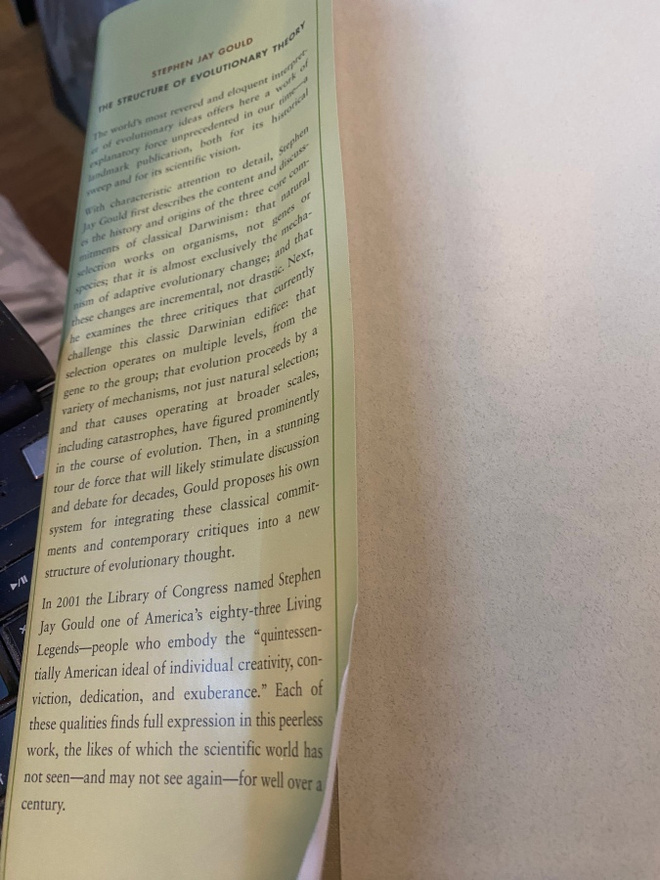
The world's most revered and eloquent interpreter of evolutionary ideas offers here a work of explanatory force unprecedented in our time--a landmark publication, both for its historical sweep and for its scientific vision.
With characteristic attention to detail, Stephen Jay Gould first describes the content and discusses the history and origins of the three core commitments of classical Darwinism: that natural selection works on organisms, not genes or species; that it is almost exclusively the mechanism of adaptive evolutionary change; and that these changes are incremental, not drastic. Next, he examines the three critiques that currently challenge this classic Darwinian edifice: that selection operates on multiple levels, from the gene to the group; that evolution proceeds by a variety of mechanisms, not just natural selection; and that causes operating at broader scales, including catastrophes, have figured prominently in the course of evolution.
Then, in a stunning tour de force that will likely stimulate discussion and debate for decades, Gould proposes his own system for integrating these classical commitments and contemporary critiques into a new structure of evolutionary thought.
In 2001 the Library of Congress named Stephen Jay Gould one of America's eighty-three Living Legends--people who embody the "quintessentially American ideal of individual creativity, conviction, dedication, and exuberance." Each of these qualities finds full expression in this peerless work, the likes of which the scientific world has not seen--and may not see again--for well over a century.
Amazon.com Review
The theory of evolution is regarded as one of the greatest glimmerings of understanding humans have ever had. It is an idea of science, not of belief, and therefore undergoes constant scrutiny and testing by argumentative evolutionary biologists. But while Darwinists may disagree on a great many things, they all operate within a (thus far) successful framework of thought first set down in The Origin of Species in 1859.
In The Structure of Evolutionary Theory, a monumental labor of academic love, Stephen Jay Gould attempts to define and revise that framework. Using the clear metaphors and personable style he is so well known for, Gould outlines the foundation of the theory and attempts to use it to show that modern evolutionary biology has lost its way. He then offers his own system for reconciling Darwin's "basic logical commitments" with the critiques of modern scientists.
Gould's massive opus begs a new look at natural selection with the full weight of history behind it. His opponents will find much to criticize, and orthodox, reductionist Darwinists might feel that Gould has given them short shrift. But as an opening monologue for the new century's biological debates, The Structure of Evolutionary Theory sets a mountainous precedent in exhaustive scholarship, careful logic, and sheer reading pleasure. --Therese Littleton
From Library Journal
The ideas and literary stylings in this massive work by MacArthur Prize Fellow Gould (Alexander Agassiz Professor of Zoology, Harvard) are both extravagantly bountiful and stupefyingly overwrought. Gould's overarching purpose is to expound upon how three main tenets of Darwinism have permuted throughout numerous historical and contemporary writings on evolutionary theory. In his erudite discussions, there is no significant school of thought that Gould fails to analyze, interpret, and contextualize thoroughly. While indisputably the product of one of the most fertile intellects of modern science, this book is also bloated, redundant, and self-indulgent. The longest chapter, at around 250 pages, celebrates Gould's own theory of punctuated equilibrium, including an interesting but utterly extraneous review of how the theory has been depicted in general culture. For its exhaustive scholarly achievement, this book is indispensable for any natural history, philosophy of science, or good general science collection. Still, the ultimate critique is that it is very highly recommended but with serious reservations. Gregg Sapp, Science Lib., SUNY at Albany
Copyright 2002 Cahners Business Information, Inc.
From Scientific American
When America's best-known scientist publishes his major work, it is an event. And The Structure of Evolutionary Theory is indeed an event, but not one aimed at the general reader. It is a monumental work, both in size (1,400-plus pages) and in scope--it sets out to do nothing less than reformulate Darwin's theory of evolution. "Nothing of Darwin's central logic has faded or fully capsized," Gould writes, "but his theory has been transformed, along his original lines, into something far different, far richer, and far more adequate to guide our understanding of nature." Among the many threads that weave through the book runs a major Gouldian theme, the idea of species selection--that species, not just individuals, compete against one another for survival. The style is vintage Gould. He opens with an extended exposition on a metaphor comparing evolutionary theory to the Duomo (Cathedral) of Milan: Darwin laid the foundation of a great edifice, but in the process of erection, the superstructure has been altered by his successors, just as construction of the Duomo occupied several centuries and incorporated an amalgam of changing styles, from Gothic to Baroque. Fascinating historical digressions, even asides about "Mr. Berra," pepper the book, so that scholarly though the work is, the nonexpert, dipping into the deep waters here and there or reading just the opening chapter, will find much to delight and to inform.
Editors of Scientific American
From Booklist
Gould's readers, dismayed at his announcement that The Lying Stones of Marrakech [BKL Ja 1 & 15 00] was his next-to-last book of essays, needn't have worried. In place of selected essays, Gould offers his magnum opus, an all-encompassing history and analysis of classical and twentieth-century evolutionary theory. This astonishing feat of scholarship and creativity is intimidating at first glance, given its bulk, but Gould's signature wit, erudition, warmth, and vigor are everywhere evident. A keenly visual thinker, he even provides an icon emblematic of his vision of Darwin's three central principles of natural selection: a drawing by the seventeenth-century scientist and artist Augustino Scilla of a three-branched articulated coral. The link between art and science is the key to Gould's literary elucidation of complex concepts, and it surfaces often in unexpected and gratifying passages. After performing a sustained, enlightening exegesis of Origin of Species, he launches an energetic history of its contentious reception, moving steadily toward a full account of his own collaborative and controversial contribution to evolutionary theory. For all its rigorous detail and painstaking historical, scientific, and philosophical explication, Gould's massive work is profoundly personal and dramatic, laced as it is with his great love for Darwin, frank intellectual autobiography, and his belief that the history of evolutionary thought "constitutes an epic tale." The beauty of this, in his words, "damnedly interminable book," is that every scientifically inclined reader will be affected by some aspect of Gould's passionate argument, humanistic sensibility, and sheer pleasure in the noble pursuit of knowledge and understanding. Donna Seaman
Copyright © American Library Association. All rights reserved
Review
“For all its rigorous detail and painstaking historical, scientific, and philosophical explication, Gould's massive work is profoundly personal and dramatic, laced as it is with his great love for Darwin, frank intellectual autobiography, and his belief that the history of evolutionary thought "constitutes an epic tale"...[E]very scientifically inclined reader, will be affected by some aspect of Gould's passionate argument, humanistic sensibility, and sheer pleasure in the noble pursuit of knowledge and understanding.”?Donna Seaman, Booklist
“Stephen Jay Gould doesn't hold anything back in this remarkable and important book. Impressive on many levels, The Structure of Evolutionary Theory represents Gould's all-out attempt to revise and extend evolutionary theory as proposed by Darwin in 1859...Gould's respect and admiration (I would even say, love) for Darwin as a scientist and as a man have been evident throughout all his writings, and this book, which begins and ends with Darwin, is no exception. In stating his motivation for it, Gould leaves no doubt that his goal is not just to explicate evolutionary theory but to laud Darwin as well...While presenting a case that should strengthen his own place in history, Gould also makes it known that he is preserving the legacy of his mentor as well, at least for now.”?Mark Davis, Ruminator Review
“[A] magisterial tome...[The Structure of Evolutionary Theory] is destined to go down in history alongside the writings of Galileo, Darwin, Huxley, Freud, Mayr and others as a work that will change its culture forever. Gould's critics (and there are plenty of them) may weep and gnash their teeth at such an assessment, but they ignore him at their--and our--peril. This man has something important to say about the preeminent origin myth of our age--evolutionary theory--and he has said it in this magnificent work.”?Michael Shermer, Washington Post
“Fascinating, discursive, dogmatic, intensely personal and often quite technical, The Structure of Evolutionary Theory is also in most of its sections readily accessible to lay readers--and well worth the effort...This summation of Gould's idiosyncratic life work will undoubtedly arouse tremendous enthusiasm in loyal Gouldites...Gould's detailed arguments and scholarly exegesis of the historical literature on evolution's forebears and conflicts fully justify the length of this book. But the nuggets of Gould, the literate and rambunctious scientist, give it delicious flavor on page after page...This is a brilliant, controversial, thorough and immensely readable updating of Darwin.”?David Perlman, San Francisco Chronicle
“The culmination of about 25 years of research and study, this book traces the history of evolutionary thought and charts a path for its future...This book presents Gould in all his incarnations: as a digressive historian, original thinker and cunning polemicist...Even Gould's opponents will recognize this as the magnum opus of one of the world's leading evolutionary thinkers.”?Publishers Weekly
“[This is] a summation of Stephen Jay Gould's life work, building on Darwinism to provide a novel synthesis of how evolution has shaped the living world...One of the joys of reading about good science is the chance not only to observe how scientific theory works, but also to participate in the workings of the mind behind the words. In Gould's...The Structure of Evolutionary Theory, the reader will find such joy in abundance.”?Tim Flannery, New York Review of Books
“The Structure of Evolutionary Theory was, we are told, ten years in the making, and is in many ways likely to be seen as Gould's greatest achievement. Of the enjoyment that many hundreds of thousands have gained from reading Gould's essays there can be no doubt...[T]here is no doubt that this is a profound and major contribution to evolutionary theory, standing high above the smoke of battle in the Darwin Wars.”?Steven Rose, Times Literary Supplement
“By literary standards [The Structure of Evolutionary Theory] is unique, a combination of scientific argument, historical analysis both of this argument and of all that went before it, an apologia pro vita sua, and many entertaining diversions...It is hard to think of any one else with this combination of polymathic ability and of sheer cheek, and equally hard to imagine filling a scientific auditorium with people who have read it right through--one of several ways in which the book can fairly be likened to The Origin of Species.”?John R. G. Turner, The Spectator
“Stephen Jay Gould's work always generates keen interest and the present volume perhaps more so given his recent death. It is a thoughtful and technical book--a statement of position and a response to critics--and it is huge...It is not a textbook as the title might suggest; instead, it is evolutionary theory as viewed through Gould's unique vision.”?Stephen Lewis, Biologist
“Stephen Jay Gould was no lightweight, physically or intellectually. This vast book...unveils his distinctive vision of evolutionary biology--as it should be, as it is, and as it has been...A book of great power, scope and learning...It is a book that one would expect to read and reread, for Gould articulates and defends a distinctive vision of the agenda of evolutionary biology; of the mechanisms of evolutionary change; and of the relationship of evolutionary biology to its own past...There is, indeed, a certain grandeur to this view of life.”?The Economist
About the Author
Stephen Jay Gould was Alexander Agassiz Professor of Zoology at Harvard University and Vincent Astor Visiting Professor of Biology at New York University. A MacArthur Prize Fellow, he received innumerable honors and awards and wrote many books, including Ontogeny and Phylogeny and Time’s Arrow, Time’s Cycle (both from Harvard).
Stephen Jay Gould (1941-2002) was the Alexander Agassiz Professor of Zoology and Professor of Geology at Harvard University. He published over twenty books, received the National Book and National Book Critics Circle Awards, and a MacArthur Fellowship.