Antiikki: Travelling Heroes - Robin Lane Fox

Kuvaus
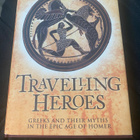
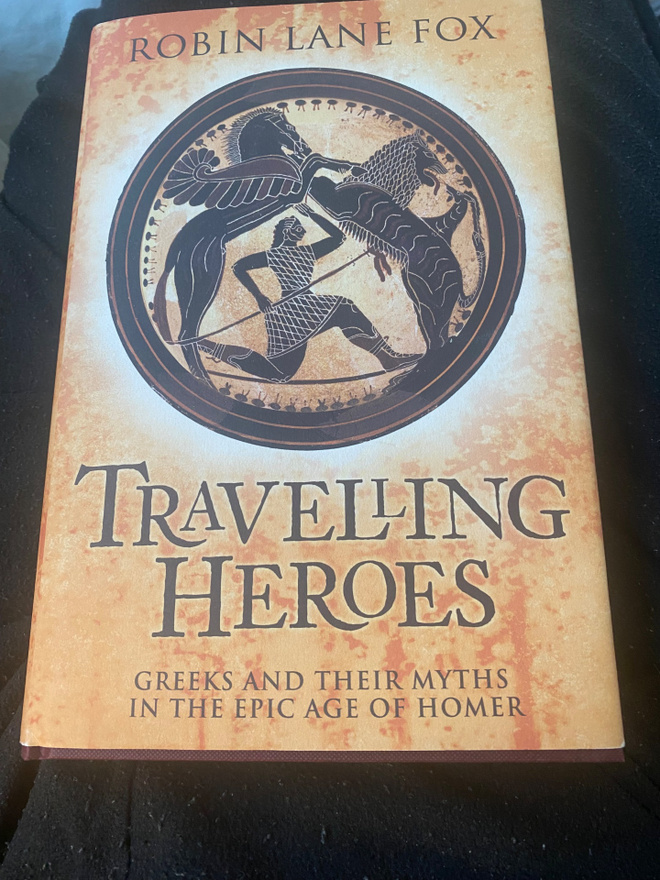
Travelling Heroes: Greeks And Their Myths In The Epic Age Of Homer. Allen Lane 2008, kovakantinen, 514 sivua.
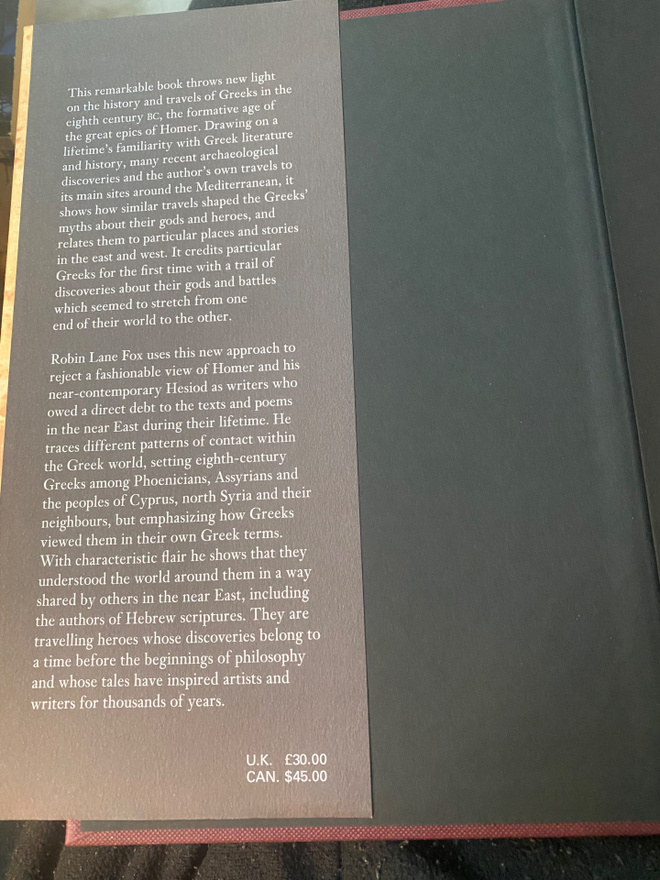
The eighth century B.C. was the formative age of the great epics of Homer, a remote and, in some ways, mysterious era. In this groundbreaking book, Robin Lane Fox takes us into that time before history to explore questions ranging from the origins of the Greek gods to the spread of classical culture in the Mediterranean world. It is a remarkable tour de force of scholarship and creative reasoning, written with flair and the authority gained from a lifetime of study and personal experience of key sites.
Presented as a kind of historical detective story, Travelling Heroes draws upon archaeology, ancient texts, and new discoveries to develop a fresh and provocative thesis: that migrants from in the Greek island of Euboea settled in specific places both in the Near East and in Italy and that what they found there helped shape their most distinctive myths. In fascinating detail, Lane Fox describes the journeys of the travellers and the contacts they made with Phoenicians, Assyrians, and the people of north Cyprus and Syria, and he shows the way they drew themes—and even references to particular topographic features—into what would become the classic stories of gods and legend. He also offers new insights into Homer himself.
Robin Lane Fox is probably the most widely read historian of the ancient Greek world, and Travelling Heroes displays the same lively originality that marked his writing about the Bible in The Unauthorized Version and about the triumph of Christianity in Pagans and Christians. Learned but never dry, controversial but soundly based, it brings a distant and nearly forgotten time brilliantly to life again.
Oxford classicist Fox explores the 700s BCE, the century to which he imputes the composition of the Iliad and the Odyssey. Explaining that this was an era of cultural contact between Greeks—specifically, those from the island Euboea—and residents of the eastern littoral of the Mediterranean Sea, he delves deeply into the nature of that exchange. Aiming to evoke the Euboeans’ mind-set, he springs from the archaeological traces of their settlements to the gods and heroes of the Near East they adapted into their own myths. While there is considerable textual explication of Homer and Hesiod involved in Fox’s procedure, he pulls the mythical characters from the pages and places them in the physical landscapes with which the Euboeans not only associated them but believed they actively inhabited. So doing lends the appealing impetus of travel writing to Fox’s account that aids readers in absorbing the world of pagan belief. Detailed but recurrently on point, Fox will connect with readers drawn to the Homeric age. --Gilbert Taylor
Review
Praise for Robin Lane Fox’s Travelling Heroes
“Fox has produced a work of prodigious scholarship. . . . A major contribution to Classical scholarship. . . . Strongly recommended.”
—Clay Williams, Library Journal
“[Robin Lane Fox’s] intellectual discipline is impressive.”
—Kirkus Reviews
The Classical World: An Epic History from Homer to Hadrian
“Fox is a fluent, perceptive color commentator on the pageant of ancient history, while giving readers some idea of where the parade was headed.”
—Publishers Weekly (starred review)
“Lane Fox's survey deserves to be widely read. Indeed, I cannot think of a better introduction to the subject for those with no prior knowledge. . . . Lane Fox's strong and clear narrative will stimulate those reacquainting themselves with this fascinating era as much as it enthralls newcomers.”
—The Washington Post
“Fox, the author of numerous works on classical civilization, is a masterful writer whose elegant but highly readable prose offers an evolving portrait of Greek and Roman culture over a period of roughly 900 years. . . . [Fox] discusses in often fascinating detail topics that are normally given short shrift in general histories. . . . This is an excellent work of scholarship and literature.”
—Booklist
The Unauthorized Version: Truth and Fiction in the Bible
“Biblical historiography, with an edge. . . . [S]ound and clearly argued. A wealth of information.”
—Kirkus Reviews
“Magnificent...delivered with authority and verve. Learned but never pedantic, [Lane Fox] is an unfailingly incisive, thought-provoking, humane, courteous, and often entertaining guide.”
—The Economist
“A remarkable achievement . . . [Lane Fox] manages, like a skilled juggler, to keep a number of intellectual balls in the air...with wit and grace. . . . The book could serve as a useful review for knowledgeable readers or as a crash course for the biblically impaired.”
—The New York Times Book Review
“[A] bracing precis of cutting-edge biblical criticism . . . The Unauthorized Version reacquaints us with one of the chief achievements of post-Enlightenment civilization.”
—Philadelphia Inquirer
“Fox does not approach his subject as an antagonist, but with the care and knowledge to make the text more meaningful. This book deserves a place in all libraries.”
—Library Journal
About the Author
Robin Lane Fox is a Fellow and Garden Master of New College, Oxford, and a University Reader in Ancient History. His books include Alexander the Great, Pagans and Christians, The Unauthorized Version, and The Classical World. Since 1970 he has also beengardening correspondent for the Financial Times.
From The Washington Post
From The Washington Post's Book World/washingtonpost.com Reviewed by Michael Dirda Over the years Robin Lane Fox -- a professor of ancient history at Oxford -- has brought out a number of scholarly yet exhilarating and reader-friendly books, including "The Search for Alexander," "Pagans & Christians" and "The Classical World: An Epic History from Homer to Hadrian." In his provocative "The Unauthorized Version: Truth and Fiction in the Bible," he dismantled many of the myths about the formation of the Hebrew Scriptures, approaching this culturally loaded material as a no-nonsense, non-believing historian. In nearly all his work, Lane Fox writes crisply about even complicated subjects, as befits a regular newspaper columnist: Besides being a noted classicist, he's also the gardening correspondent for the Financial Times. So I looked forward to enjoying "Travelling Heroes." I was even prepped for it: A year or so back I had happened to reread the "Iliad" and the "Odyssey" and had done some collateral research into ancient Greek history and myth. Consequently, I figured that I was as well prepared a common reader as one might expect for this new look at the Mediterranean and Near Eastern culture of the 8th century B.C. Nonetheless, the book nearly defeated me. Lane Fox's thesis, to quote from the dust jacket, is that "migrants from the Greek island of Euboea settled in specific places both in the Near East and in Italy and that what they found there helped shape their most distinctive myths." In particular, topographic features, misconstrued names and indigenous local rites led to the association of already existing Greek classical myths and figures with particular geographical places. For instance, when Phoenicians in Cilicia (part of modern-day Turkey) said the word "Mopsu" -- a reference to a ruling house of Muksas or Mopsu -- the Greeks naturally heard the word "Mopsus," the name of one of their own legendary seers. Hence Mopsus, like Kilroy, had been there at some earlier time. "The Greek visitors did not invent a new mythical hero Mopsus in order to fit this 'Mopsu' into their own past," Lane Fox writes. "In their Greek myths they had such a hero already, the Mopsus who came from Greece and Claros. The names were irresistibly similar and the connection did not require great learning." What's more, to the Greeks, "a verbal coincidence often seemed like a sign or an omen." According to Lane Fox, these sailors from the island of Euboea, along with the Phoenicians, were the Mediterranean's greatest travelers and seem to have served as cultural Johnny Appleseeds. Much of "Travelling Heroes" focuses on archaeological digs and drinking cups, bowls and other bits of ancient dinnerware. Such physical evidence, as well as certain myths and fragments of poetry, suggests that Euboeans once lived in north Syria at a place called Al Mina, and also in east Sicily and in north Africa. These people were, according to one study, the mid-8th-century's "masters of the trade between the East Mediterranean and central Italy." So far, so good. As Lane Fox insists, "Their travels included journeys eastwards and with them as they travelled went a baggage of specific myths which they already knew. As we shall discover, they encountered myths in foreign lands which they assimilated too. They then believed that they had found specific items in these very same myths as they continued to travel even further across the sea. Particular myths thus became located like a 'songline' across the entire span of their travels." Lane Fox further explains that "we have followed the tracks of the Euboeans and their objects so closely because the trail of myths which they also laid will depend on their contacts with exactly located sites and landscapes." The point, if I've got this right, is that the Euboeans brought their myths with them, then happened to observe a distinctive rocky promontory or strangely shaped bay near some distant shore, or perhaps heard stories from the indigenous people of the East that recalled what they already knew. So they concluded, using myth-tinted imaginations, this must be the very place where Adonis, Heracles or the monstrous Typhon performed some marvel, or where the various ancient heroes tarried during their return from Troy. "If people in the west were well aware of Homer," argues Lane Fox, "surely they would want to locate some of his spellbinding stories in the 'new world' which they had found? In due course, most of the Homeric stories came to be placed on the east coast of Sicily or up by the Bay of Naples, along the very routes taken by Euboeans who traveled there from c. 800-780 BC onwards." Throughout "Travelling Heroes," Lane Fox labors relentlessly to prove the connection of various myth sites with Euboean trading posts. Consequently, his book is not merely scholarly, but also detailed and repetitive. Each chapter brings one more bit of pottery, one more name similarity, some possible association with Euboeans. Everything is scrupulously presented, and yet the sum total for this reader was first information overload, then tedium. One hungers for a clearer sense of why all this matters -- and for more of the charming facts that occasionally enliven these pages. Did you know that Dido, who killed herself out of love for Aeneas (see Virgil's "Aeneid"), was the niece of the Bible's Queen Jezebel? Or that Antony and Cleopatra's daughter married a learned King Juba, who traced his ancestry back to Heracles? The city of Lisbon was once called Olisippo, a name derived from that of Odysseus/Ulysses. The Greeks, we're told, "steered by the Great Bear, whereas Phoenicians more advisedly steered by the Little Bear" (that is, by the Big or Little Dipper). In a grave on Ischia there was discovered some pottery inscribed this way: "I am Nestor's cup, good to drink with, but whoever drinks from this cup, at once the desire of fair-crowned Aphrodite will seize him." Lane Fox calls this Europe's earliest literary allusion, since it clearly refers to Homer's "Iliad": Nestor -- the elderly counselor to the Greeks at Troy -- is said to possess a similar drinking vessel heavily embossed with gold. "Travelling Heroes" is unquestionably an important book, but its subject is too arcane, too specialized and too speculative for people with only a passing interest in classical antiquity. Why, I wonder, did a trade publisher bring it out? It should have been the ornament of some scholarly press's spring catalogue.
Copyright 2009, The Washington Post. All Rights Reserved.
Excerpt. © Reprinted by permission. All rights reserved.
Chapter 1
Hera’s Flight
In the fifteenth book of Homer’s Iliad, the goddess Hera flies across to Mount Olympus and the poet compares her to a particular movement of the human mind. When a man has travelled far and wide, he tells us, his mind will sometimes leap and he will think, “I wish I was here, or I wish I was there,” as he “longs for many different things.” Hera’s sideways flight is as swift as these inconsistent thoughts as she moves from the peak of one mountain to another.
Two thousand seven hundred years later we still know from inner experience what Homer meant. We do not connect such thoughts with the speed of a passing goddess, which we imagine, rather, as the invisible speed of light. Homer’s imagination is so much more precise. When a goddess descends directly to earth he compares her descent to a vertical shower of hailstones. When she flies sideways he refers us inwards to those lateral fancies which express our enduring sense that life does not have to be as it is.
Two thousand seven hundred years are a very long gap between Homer and ourselves and at such a distance the psychology of his heroes has been thought by some of his modern readers to be primitive. Homer’s heroes think in their “hearts,” not their brains; like us, they can disown an idea or impulse, but they often disown it as if it has come from outside or from an independent source; they have no word for a decision and because they are not yet philosophers they have no word for the self. Yet, as Hera’s flight reminds us, Homer’s idea of the mind is not limited by the words which he happens to use. Like ours, his heroes’ inconsistent thoughts belong in one unifying mind; they decide on actions; like Hector outside the walls of Troy they sometimes know what is best, but fail to act on their knowledge. Above all, they share our human hallmark, the sense that our life could be lived elsewhere and that people once loved and lost can seem in the contrasts of the present as if they were never really so.
“I wish I was here, or I wish I was there . . .” In our age of global travel we are all potential heirs to the simile of Hera’s flight. Among writers it may seem most apt for novelists, the idealized heroes of our habits of reading. Novelists, surely, need to imagine, whereas earth-bound historians have only to collect such mundane information as survives. Yet novelists become constrained by their own creations and by the need for them to be coherent as they develop. Historians must amass and collect but they then have freedoms too. It is for them to assess the credentials of what survives, to pose questions which some of it helps to answer, and to check that there is not other evidence which tells against their answer and which cannot be explained. As they reconstruct a life, a practice or a social group, their sources control their image of it, but they also need to imagine what lies beyond their surface, the significant absences and the latent forces. When they imagine these absentees they need to think how life would have been beyond their own particular lives. “I wish I was here, or I wish I was there . . .”: these thoughts also flash in minds which have travelled far among evidence for other times and places.
Philosophers will continue to tell us that it is an illusion, that historians cannot be in two times at once or travel backwards while remaining themselves. Yet we “long for many different things,” to be good, perhaps, in the new age of the first Christian emperor Constantine, to be wonderfully wild with Alexander the Great, to question convention in Socrates’ Athens or to uphold it on an estate of outrageous size in late Roman north Africa, with the names and pictures of the family’s beloved horses on the villa’s mosaic flooring, a Christian saint’s shrine on the farm for the prayers of the indebted tenants and a strong sympathy with that least Christianized company of Christians, the nearby members of Augustine’s congregation.
We can only wish, simulating Hera’s flight, but after travelling far and wide among evidence for the years from Homer to Muhammad, I continue to wish to revisit the Greek world of the eighth century bc. It is not a world with famous names, who are exactly dated and known from biographies. It is not even known through histories or memoirs which were written in its period: history had not yet been invented. Its main sources are particularly hard to interpret: poetry and archaeological finds. From the latter, especially, modern scholars have described this period as a “Greek renaissance,” or an age of distinctive “structural transformation,” propelled, perhaps, by a newly increasing population, an increased use of cultivable land and a new willingness of its village-leaders to combine into city-states. One sign of these changes is even discerned in the use of organized burial grounds for the dead. Others detect the origins of icons of our “western world,” the birth of the “free market” after an age of exchange based on reciprocal favours, or the unencumbered ownership of small family farms, the birthright of those “other Greeks,” the small farmers whom our modern histories of warriors and lawgivers tend to pass over.
It would be intriguing to test these theories by revisiting their eighth-century reality, but my own researches would be different. I would like to verify a pattern long visible to my eye, a trail of travel and myth traced by eighth-century Greeks, which stretched across the Mediterranean and is the subject of this book. Hitherto unrecognized, it bears on other great elements of ancient life to which we still respond, aspects of landscape, songs and oracles and the unsurpassed poetry of Homer and his near-contemporaries. It also points to a way of thinking and of understanding the world which is not prominent in modern histories of this early period but which was active from Israel to the furthest points of the Greeks’ presence, at a time when philosophy did not yet exist and there was no separate sphere of “western thought.”
Realists in the modern world will raise immediate objections to this wish to return to the edges of what appears to be such a dark age. Life expectancy was low in the eighth century; there was extreme exploitation of the many by the very few; there were the past’s invisible companions, intense smell and pain, compounded by the absence of flushing drains and lavatories. Among Greeks there was grumbling sexism, best seen in the myth of Pandora, the origin of man’s sufferings, and “from Homer to the end of Greek literature there were no ordinary words with the specific meanings ‘husband’ and ‘wife.’ ” There was also an absence of small significant comforts, no sugar, no chocolate, no pianos. In the dry spines of a Greek landscape were there ever horses worth riding? Objects and painted pottery of the period show men naked, not clothed, and surely those Greeks who competed in sports and races had to do so in the nude? It is a mercy that our lives have moved on . . .
Such objections are not all misplaced. Excavators of two of the best- studied cemeteries in the Greek world between 1000 and 750 bc have given few grounds for optimism. At Lefkandi, on the island of Euboea, “the most complete burials confirmed that adults tended to die quite young . . . in the prime of life, say between 17 and 40 years. The young persons recovered from all three cemeteries indicate that child mortality, too, was probably high.” At San Montano on the island of Ischia, where Greeks settled from c. 770, “the cemetery population was divided roughly into one-third adult and two-thirds pre-adult,” 27 per cent of whom were babies “often new or stillborn.” Studies of bones, teeth and skeletons at these and other Greek sites in this period imply a distressing proportion of damage, decay and distortion. At Pydna, up on the coast of south-east Macedon, a sample of forty buried skeletons has shown that “degenerative joint diseases emerge early, from 13–24, and concern both sexes . . . At least nine individuals in our sample were suffering from arthritic changes, mainly in the spinal column . . . both of the individuals over 45 years show severe arthritic changes.”
For those who lived on there were no human rights, no challenge as yet to the domination of the many by the powerful ruling few. Without compunction, this “happy few” enslaved fellow-humans, using them in households or on their farms. They might even sell
tiresome dependants abroad, as the suitors in Homer’s Odyssey acknowledged when they told Odysseus’ son to pack off two troublesome beggars to “the Sicels’ (in our Sicily) in the west “in order to fetch for yourself a worthy price”; they were unaware that one of them was noble Odysseus himself, in disguise. Slavery, meanwhile, was only the most extreme form of gain. In Attica, the nobles also took one-sixth of the produce of other Attic landowners’ farms. In Sparta, by the late eighth century, the Spartans were taking half of the produce of the Greek neighbours whom they had conquered and made their “serfs.”
These obstacles will hang over my wish to revisit this era unless they are agreed on and countered at the outset, from the high mortality to the nudity in public. The one counter to an early death was a lucky draw in the lottery of life. In the eighth century such a draw was possible, although the odds against it were much higher than ours. The “average” lengths of eighth-century life in some of our modern tables include all the unlucky others and obscure the peaks and valleys of an individual’s span. Prospects were longer for those who survived the acute risk of infant mortality. Individual males who passed through this ...